


Researchers from Leiden University and other institutions have discovered that peptides can form under the extremely cold conditions found in space, without the need for UV radiation or cosmic radiation. The results show that simple molecules and atoms can spontaneously develop into increasingly complex organic compounds, even before planets have formed. The research has been published in the journal Communications Chemistry.
At first glance, space may not seem like an ideal place for complex chemistry. In dark regions where new stars are forming, temperatures can fall to just ten degrees above absolute zero. Yet chemical reactions can still take place under these conditions, eventually leading to relatively complex molecules. Astrochemists have now demonstrated in the laboratory that a range of peptides can form in such environments. Peptides are short chains of amino acids and play an important role in living organisms. Amino acids can be thought of as the Lego bricks of life: peptides are formed when these building blocks are linked together.
Hydrogen plays a key role
Previous research had already shown that simple substances commonly found in space, such as water, ammonia and carbon monoxide, can react with one another when hydrogen or carbon atoms accrete onto cold surfaces. These reactions can produce, among other things, amino acids. The new experiments show that this chemistry can go much further.
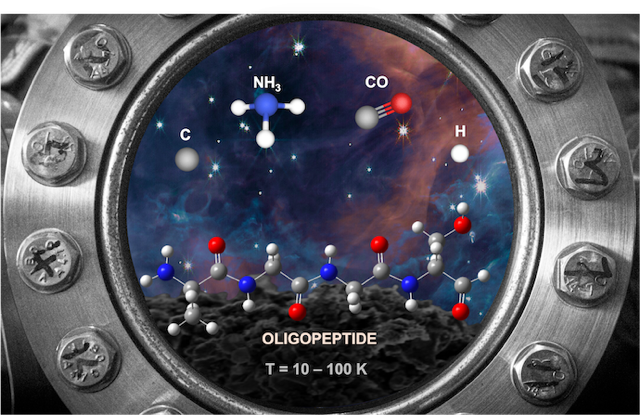
The researchers found evidence for peptides containing building blocks derived from several different amino acids, including glycine, alanine and serine. Longer chains also formed, consisting of up to five building blocks. Atomic hydrogen appears to be particularly important. Hydrogen is the most abundant element in the universe and enables additional chemical reactions to occur. As a result, not only are more peptides produced, but a greater variety of molecules can form as well.
“Our results suggest that chemistry in space may not first need to produce every individual amino acid as a separate building block,” says co-author Ko-Ju Chuang of Leiden Observatory and PRELIFE. “Simple molecules can form reactive intermediates that subsequently polymerise directly into peptides. In this way, molecular complexity can arise before planets are formed.”
Chemistry that reinforces itself
The researchers made another striking discovery. Organic material produced during an initial reaction appears to accelerate the formation of new peptides. When new atoms and molecules were deposited onto a surface on which many peptides were already present, the production of longer peptides increased substantially. The existing peptides did not simply become incorporated into the new molecules. Instead, they appear to promote the chemical reactions in another way.
This raises the intriguing possibility that chemical processes in space can, to some extent, reinforce themselves. Molecules formed during an earlier stage could help facilitate the formation of a subsequent generation of more complex molecules.
The researchers emphasise that this does not mean that life itself has emerged through this process. However, such mechanisms may have contributed to the development of increasingly complex molecules that could later have played an important role in prebiotic chemistry on young planets.
A piece of space in the laboratory
For their experiments, the researchers used the SURFRESIDE setup at the Laboratory for Astrophysics of Leiden Observatory. This allowed them to recreate conditions found on cold dust grains between the stars. They brought carbon atoms, hydrogen atoms, carbon monoxide and ammonia together on a gold-coated surface. The surface was cooled to just 10 kelvin, approximately −263 °C.
Using infrared spectroscopy, the researchers monitored the chemical reactions as they occurred. Afterwards, they analysed the organic material that had formed using highly sensitive analytical techniques.
“It is fantastic that the experiments reveal two unexpected aspects of interstellar chemistry,” says co-author Franciele Kruczkiewicz, a Marie Curie Fellow at Leiden Observatory. “This study provides experimental evidence for chemically driven processes and hints at potentially autocatalytic, or self-accelerating, behaviour. We will carry out further experiments to establish this conclusively.”
The results therefore provide a new perspective on chemistry in space: even in an environment that is almost unimaginably cold, simple ingredients can gradually develop into increasingly complex molecules.
More information
Contact
Ko-Ju Chuang, Leiden Observatory / Leiden University / PRELIFE consortium
Email: chuang@strw.leidenuniv.nl
Article
“Catalytic non-energetic formation of diverse peptides on cosmic dust under extraterrestrial conditions”. Serge A. Krasnokutski, Franciele Kruczkiewicz, Cedrick Bourseau, Quentin Remaury, Claude Geffroy, Nico Ueberschaar, Pauline Poino & Ko-Ju Chuang. The article was published in Communications Chemistry.
https://www.nature.com/articles/s42004-026-02159-4
Image
The formation of oligopeptides in cold space. The addition of atomic hydrogen significantly enhances the polymerisation and diversity of peptides in interstellar environments.
About PRELIFE
The consortium ‘PRELIFE – Pathways, Reactions, and Environments Leading to Life’ investigates the origins of life on Earth and in the universe with funding from the Dutch Research Agenda (NWA) programme of the Dutch Research Council (NWO). The consortium consists of scientists from sixteen universities and research institutes in the Netherlands, as well as experts in science communication and education.